


Booking points might sound like something invented by accountants who got bored watching football, but they’ve become one of the most popular betting markets in the sport. Unlike traditional card betting where you simply count yellows and reds, booking points assign numerical values to each card, creating a more nuanced way to wager on match discipline. If you’ve ever wondered why your mate keeps talking about “over 45.5 points” during a heated derby, this guide will explain everything you need to know.
The system itself is beautifully simple once you understand the fundamentals. A yellow card is worth 10 points. A straight red card carries 25 points. When a player receives two yellow cards and subsequently gets sent off, the total comes to 35 points rather than the 45 you might logically expect. This distinction trips up many newcomers who assume the second yellow counts separately before the red arrives. It doesn’t. The system treats the dismissal as a single disciplinary event worth 35 points: 10 for the first yellow plus 25 for the red that follows the second yellow. Bookmakers across the industry have standardised this approach, so whether you’re betting with a major UK operator or an Asian book, you’ll encounter the same calculation method.
Understanding why booking points exist requires stepping back from the numbers momentarily. Traditional card markets only track quantity, treating a match with four yellows identically to one with three yellows and a red. But those two scenarios represent vastly different disciplinary situations. The match with the red card featured more severe misconduct, a player dismissed, and potentially ten minutes of chaos before order was restored. Booking points capture this distinction by weighting red cards more heavily than their yellow counterparts. From a betting perspective, this creates opportunities that simple card counts would miss entirely.
The Mathematics Behind Different Scenarios
Let’s work through some practical examples because abstract numbers only become meaningful when applied to real situations. Consider a fairly typical Premier League match that produces four yellow cards and nothing more. Under the booking points system, that’s 40 points total, a number that would likely fall under most bookmaker lines set around 45.5 for standard fixtures. Now imagine the same match but with one of those yellows becoming a second booking for the same player. Suddenly you have three yellows (30 points) plus the two-yellow dismissal (35 points), totalling 65 points. The match didn’t necessarily become rougher, but the booking points tell a different story.
The maths become even more interesting when straight red cards enter the equation. A relatively clean match that produces two yellows and a horror tackle resulting in a straight dismissal would yield 45 points: 20 from the yellows plus 25 from the red. Compare this to a niggly affair with five yellows and no red, which produces 50 points. Despite the straight red representing more severe misconduct, the booking points actually favour the match with more frequent minor infractions. Smart bettors exploit this asymmetry by identifying matches where red card probability is elevated but yellow card likelihood might be suppressed, such as high-stakes knockout matches where players know consequences are severe.
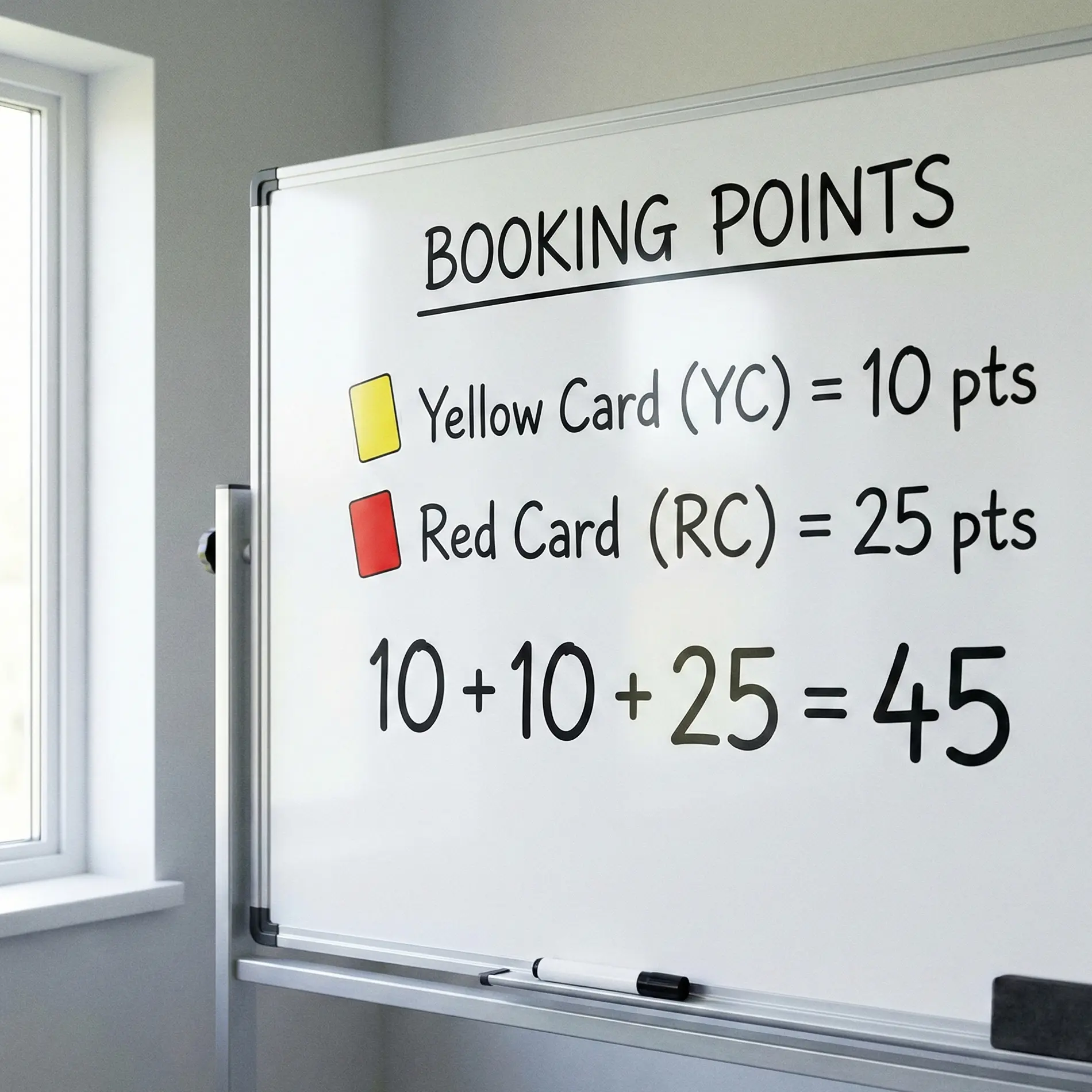
The maximum points a single player can contribute is 35, achieved through the two-yellow-then-red sequence. This cap exists because the system doesn’t count the second yellow independently; it merely triggers the red card portion. No player can accumulate more than 35 points regardless of how many cautionable offences they commit before being sent off. However, this cap only applies to individuals. A match with multiple sendings-off can theoretically produce enormous booking points totals, though such fixtures remain relatively rare. The 2010 World Cup match between Netherlands and Spain produced 14 yellows and one red, a booking points total that would have smashed any line a bookmaker might have set.
Focus entirely on finding betting value.
Settlement Rules and Edge Cases
One area that causes confusion involves when and how bookmakers settle booking points bets. The vast majority of operators settle these markets at the end of 90 minutes plus injury time, excluding extra time periods in cup matches. This matters enormously because extra time often produces additional bookings as tired players make desperate challenges. If you’re betting on a cup fixture, verify whether your chosen bookmaker includes extra time in their settlement terms. Some do, most don’t, and the difference can transform a winning bet into a loser.
Cards shown to managers, coaching staff, and substitute players on the bench typically do not count toward booking points totals. Only cards issued to players actively participating in the match contribute to the final tally. This rule applies even when a manager receives a red card for touchline behaviour and gets sent to the stands. The booking points market concerns itself exclusively with on-pitch discipline, which makes sense given that the market aims to measure the disciplinary character of the actual football being played rather than sideline theatrics.
VAR introduces additional complexity that modern bettors must consider. When video review leads to a red card upgrade from a yellow, the booking points reflect the final decision rather than the initial one. Similarly, when VAR overturns a red card to a yellow, the reduced penalty applies to the booking points calculation. These decisions occasionally arrive minutes after the original incident, creating brief windows where the “true” booking points total differs from what bettors might assume based on what they witnessed. Bookmakers typically wait for official confirmation before settling markets, but in-play bettors should remain aware that VAR can alter expected totals.
Practical Application and Market Types
Booking points markets come in several varieties, each offering different risk-reward profiles. The most common is the simple over/under line, where bookmakers set a threshold like 45.5 points and you predict whether the actual total will exceed or fall short of that number. These lines typically carry odds close to evens on both sides, with slight adjustments reflecting the bookmaker’s assessment of where the market truly sits. Alternative lines at 35.5, 55.5, or higher offer different odds, allowing you to express varying degrees of conviction.
Team booking points markets isolate one side’s disciplinary record within the match. If you believe Manchester City will dominate possession against a mid-table opponent who spends the entire match chasing shadows and making desperate tackles, you might target the opposition’s team booking points rather than the match total. These markets sometimes offer better value because bookmakers price them based on overall match expectations rather than the specific tactical dynamics that might emerge. A deep-defending team will commit fouls; that’s simply how football works when you’re under siege for 90 minutes.
Booking points handicaps represent the sophisticated end of the market, applying the same principles as goal handicaps to card accumulation. If you believe Arsenal will receive significantly fewer cards than their opponents in a given fixture, you might back them with a +5.5 booking points handicap. This means Arsenal’s booking points total plus 5.5 must still be lower than their opponent’s for your bet to win. These markets reward bettors who can accurately predict not just the overall disciplinary nature of a match but the relative card distribution between teams.
Building Your Booking Points Strategy

Success in booking points betting requires moving beyond gut feelings about which matches will be “feisty.” The referee appointment matters enormously because officials vary dramatically in their willingness to reach for cards. Some Premier League referees average over 5 cards per match while others barely surpass 3. Identifying which referee will officiate a fixture should be your first research step, conducted as soon as appointments are announced, typically midweek before weekend matches.
Team-level analysis should focus on tactical approach rather than reputation. A team’s card accumulation often reflects their playing style more than their aggression. High-pressing sides that lose possession frequently may commit more recovery fouls than defensively solid teams who simply shepherd attackers toward unthreatening areas. Counter-attacking teams face different challenges, needing to halt opposition momentum through tactical fouls when transitions stall. Understanding why teams receive cards, not just how many, helps predict booking points in unfamiliar matchups.
Historical head-to-head data provides context but requires careful interpretation. Two teams might have historically produced high-card fixtures, but managerial changes, squad turnover, and shifting tactical philosophies can render that history irrelevant. Weight recent meetings more heavily than distant ones, and always consider whether the personnel and playing styles that generated previous disciplinary chaos remain in place. A rivalry match might typically produce 60+ booking points, but that trend means nothing if both teams now employ patient possession football under new managers.
The best booking points bettors develop models that account for multiple variables simultaneously: referee tendencies, team styles, match stakes, weather conditions, and even the psychological state of key players carrying suspension risk. This multi-factor approach sounds complex, but it really just means thinking systematically rather than emotionally about what drives cards in football. Most casual bettors overestimate the importance of rivalry and underestimate the impact of tactical matchups. That’s where value lives in booking points markets.
Build a solid betting base at card bet.
