

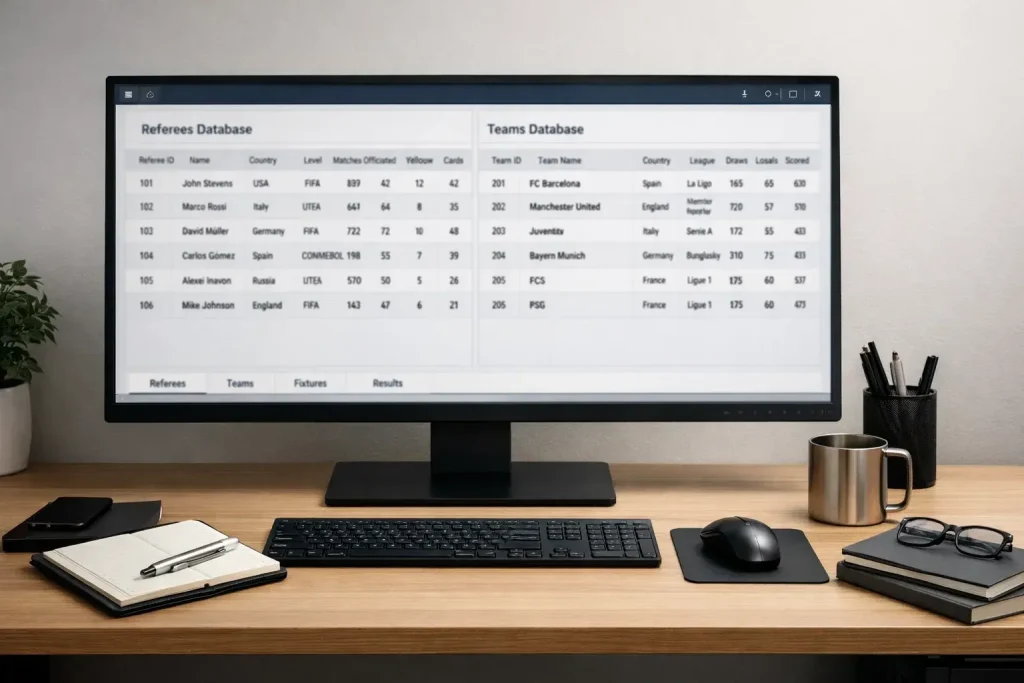
Sustainable card betting success requires systematic data collection rather than ad-hoc research before individual matches. Building and maintaining a statistical database transforms scattered information into organised knowledge that compounds over time. While casual bettors scramble to check referee stats before each fixture, database-equipped bettors access comprehensive profiles instantly, make faster decisions, and identify patterns that sporadic research misses. The initial investment in database construction pays dividends across every subsequent bet.
The principle underlying database betting is simple: structured information enables better decisions. When you maintain organised records of referee tendencies, team discipline patterns, and historical fixture data, you eliminate the rushed pre-match research that leads to incomplete analysis. Your database becomes a competitive advantage because most bettors don’t make this investment, relying instead on whatever information they can gather in the hours before matches. The effort required to build proper systems deters many, which is precisely why those who make the effort gain edge.
Database construction requires upfront time investment but reduces ongoing maintenance to manageable levels. Once systems are established, updating after each matchweek takes minutes rather than hours. The key is building sustainable processes from the start—structures that are easy to update, metrics that are straightforward to calculate, and formats that support quick retrieval when betting decisions demand fast access to historical patterns.
Play safe over under bets.
Essential Metrics for Card Betting Databases
Referee statistics form the foundation of any card betting database because officiating influence on card outcomes exceeds most other variables. For each referee, track cards per match (separating yellows and reds), first-card timing, home versus away card distribution, and any notable patterns with specific teams. These metrics should cover current season data weighted heavily while maintaining rolling averages from previous seasons for context. The goal is a complete profile accessible within seconds when referee assignments emerge.
Team discipline data requires tracking from multiple angles. Record cards received per match (overall, home, and away), cards conceded to opponents, and cards in different match contexts (versus top teams, relegation rivals, and mid-table opposition). Break down team cards by half to identify whether clubs accumulate discipline issues early or late in matches. This granular data reveals patterns that simple season averages obscure.

Player-level tracking becomes relevant for player-to-be-booked markets. Maintain records of individual card counts, cards per 90 minutes, and any opponent-specific patterns. Focus tracking on players who appear regularly in card markets—defensive midfielders, aggressive full-backs, and known card accumulators—rather than attempting comprehensive coverage of every squad member. Targeted tracking produces actionable insights without overwhelming data management requirements.
Data Sources and Collection Methods
Free statistics websites provide foundation data for card betting databases. Sites like WhoScored, FBref, and FootyStats offer team and player discipline statistics that serve as starting points. Referee statistics appear on dedicated sites like ThePuntersPage or through general statistics platforms. These free resources provide sufficient data for building functional databases, though serious bettors might supplement with premium services for additional detail.
Manual tracking supplements automated data sources by capturing information that websites don’t provide. When you watch matches, note observations about referee style, player behaviour, and match dynamics that don’t appear in standard statistics. These qualitative observations enrich quantitative data, providing context that pure numbers lack. A note that “Referee X struggled to control the first half, seemed flustered” adds meaning to the cards-per-match figure in ways that improve future predictions.
Historical data depth affects database utility. Current-season statistics provide the most relevant information, but longer historical records reveal whether patterns are stable or recent developments. A referee who has averaged 4.5 cards across three seasons offers more reliable projection than one with similar averages across only ten matches. Balance recency (recent data predicts better than distant data) against sample size (more data reduces noise) when determining how much history to maintain.
Database Structure and Organisation
Spreadsheet-based databases work effectively for individual bettors who don’t require enterprise-scale solutions. Microsoft Excel or Google Sheets provide sufficient functionality for tracking hundreds of referees, teams, and players. The key is consistent structure—standardised column headers, uniform data formats, and logical organisation that enables quick filtering and searching. Time invested in proper structure pays dividends when you need information quickly before betting windows close.
Separate sheets or tabs for different data categories prevent overwhelming complexity. Maintain distinct sections for referee statistics, team discipline data, player records, and fixture history. Link sheets where useful—fixture records might reference referee sheets for official assignment—but keep each category independently navigable. This modular approach makes updates manageable and retrieval intuitive.
Naming conventions and date formats require consistency from database inception. Decide how you’ll refer to teams (full names versus abbreviations), how dates will be formatted, and how you’ll handle competitions (league versus cup versus European) before entering data. Inconsistent formatting creates retrieval problems and analysis errors that compound over time. Standardise early and maintain discipline throughout.
Analysis Techniques for Card Data
Comparative analysis against league averages provides context for individual statistics. A referee averaging 4.0 cards per match in a league averaging 3.5 is notably strict; the same 4.0 average in a league averaging 4.5 indicates relative leniency. Always assess individual figures against appropriate baselines rather than treating raw numbers as absolute indicators. Your database should maintain league averages that enable these comparisons.
Trend identification requires examining sequences rather than single data points. If a referee’s last five matches show increasing card counts, this trend might predict their next performance better than their season average. Similarly, a team experiencing disciplinary problems across recent fixtures might continue that pattern regardless of longer-term history. Build analysis approaches that capture recent form alongside overall averages.

Correlation analysis reveals relationships between variables that inform betting strategy. Does a specific referee show elevated cards against certain team types? Do particular teams accumulate cards primarily in first halves or second halves? Do card counts correlate with match stakes or rivalry intensity? Your database enables these investigations, but you must actively explore relationships rather than passively storing numbers.
Maintaining and Updating Your Database
Post-matchweek updates should follow consistent processes that capture all relevant information. After each round of fixtures, update referee records with cards shown, team records with cards received and conceded, and player records for any individuals you’re tracking. This regular cadence prevents data gaps and ensures your database reflects current reality rather than outdated patterns.
Quality control catches errors before they corrupt analysis. Periodically verify that your data matches authoritative sources, checking for transcription errors or missed updates. Cross-reference totals—do individual match cards sum correctly to season totals? Do team records match referee records for shared fixtures? These checks maintain database integrity that sloppy maintenance would erode.
Seasonal resets and archive procedures ensure databases remain manageable across years. At season’s end, archive completed season data while carrying forward information relevant to ongoing analysis—referee career statistics, team historical patterns, and player discipline records. Starting each season with clean current-year tracking while maintaining historical reference balances data relevance against retrieval complexity.
From Database to Betting Decisions
Pre-match workflow should incorporate database consultation at appropriate points. When fixtures are announced, check team discipline records and rivalry history. When referee assignments emerge, pull official profiles and assess how their tendencies interact with the teams involved. This systematic approach ensures you consider all relevant database information before making betting decisions.
Identifying database-driven edge means comparing your data-informed assessment against market prices. If your database suggests a referee averages 5.2 cards per match against physical teams and the appointed fixture features two physical sides, calculate your expected cards and compare against the line. When your database-informed projection differs meaningfully from market pricing, you’ve potentially identified value.
Database limitations require acknowledgment alongside database benefits. Historical patterns don’t guarantee future outcomes; they simply inform probabilities. A strict referee might have an unusually lenient day; a disciplined team might receive multiple cards. Your database improves prediction quality without eliminating uncertainty. Use database insights to inform decisions while maintaining appropriate humility about prediction limits.
Building and maintaining a card betting database requires commitment that casual bettors won’t provide. This commitment creates competitive advantage precisely because it’s demanding—the edge exists because others don’t make the effort. Invest in proper database construction, maintain it consistently, and develop analytical approaches that extract insight from your collected data, and you’ll make better card betting decisions than bettors relying on scattered pre-match research.
Reduce your big losses on card bet.
